
The Lost Connection Between Trinity and Tawhid
Ramon Llull’s Lost Insight That Bridges Christianity and Islam Across the Ages

Few theological topics have generated more confusion, debate, and mutual suspicion between Christians and Muslims than the doctrines of the Trinity and tawḥīd.
For centuries, both communities have often viewed the other’s teaching not simply as different, but as fundamentally mistaken — even threatening to the very essence of monotheism.
Muslims, committed to the uncompromising unity of God, have frequently understood the Trinity as a form of association (shirk): the dividing of the divine into multiple beings.
Christians, committed to God as a communion of Father, Son, and Spirit, have sometimes viewed tawḥīd as overly abstract or impersonal — a unity lacking relational depth.
In both directions, misunderstandings have accumulated.
Caricatures replaced careful reading.
Polemics overshadowed reflection.
And the possibility of seeing these doctrines as anything but mutually exclusive seemed impossible.
Yet within this long history, there stands one figure whose work cuts through the inherited confusion with unusual clarity and intellectual generosity: Ramon Llull (1232–1316).
Llull did something remarkably rare for his time — and still rare today.
He studied both Christian theology and Islamic philosophical thought, learned Arabic, and engaged with Muslim scholars not to attack their beliefs, but to understand their reasoning.
Instead of forcing the Trinity against tawḥīd, or tawḥīd against the Trinity, he asked a more fundamental question:
What if both doctrines, properly understood, illuminate a deeper truth about God’s unity?
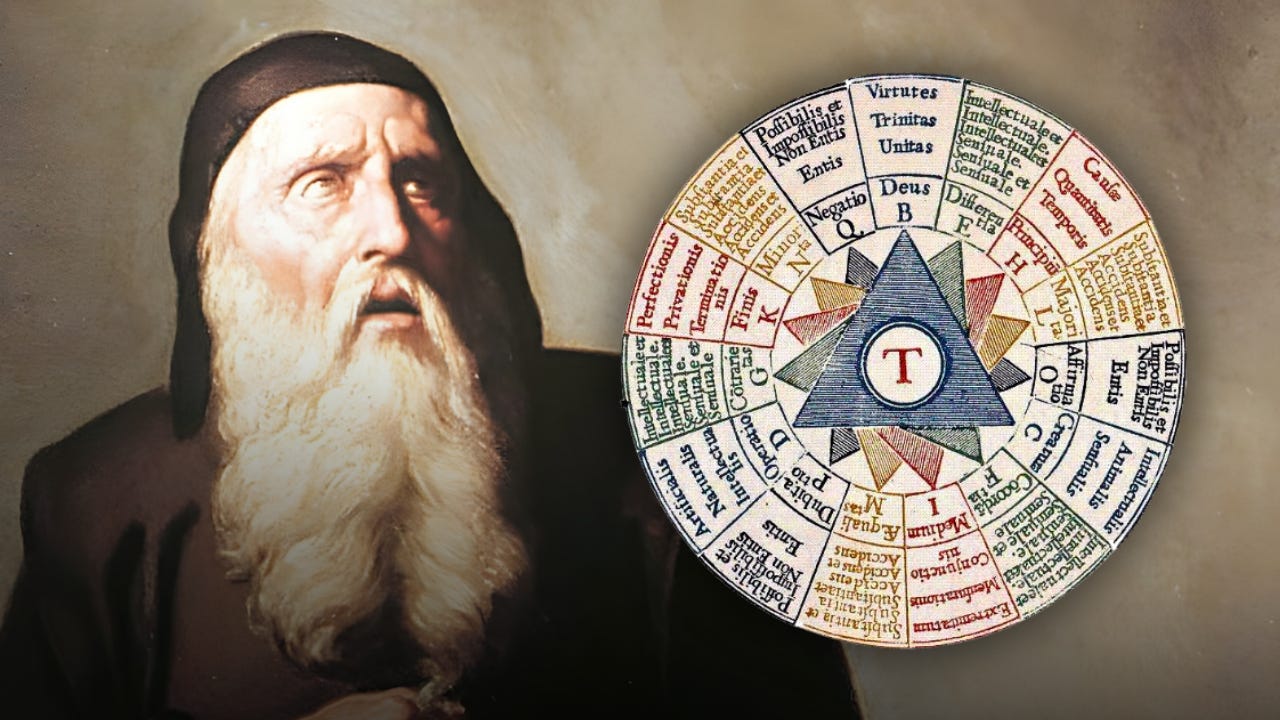
Through his Ars Magna — a system of diagrams, logical structures, and relational principles — Llull attempted to show that the Christian confession of one divine essence in three eternal relations, and the Islamic affirmation of God’s absolute oneness, need not be opposites.
Rather, he believed both traditions were grasping aspects of a single reality:
God is one (tawḥīd affirms this clearly).
God is living, wise, and loving (Christianity explores this inner life of God).
Divine unity does not exclude relational fullness, nor does relational fullness contradict unity.
Llull’s work suggests that much of the historical conflict arose not from the doctrines themselves, but from mutual misunderstandings and from imposing categories inappropriate to the other’s theological language.
He recognized that each tradition developed its concepts of God within different intellectual frameworks — and that these frameworks often spoke past one another.
By re-examining both doctrines through Llull’s analytical method, we can begin to see:
where each tradition misunderstood the other,
how certain critiques were based on misconceptions, and
how a more careful reading reveals unexpected points of harmony.
This article approaches Llull not as a figure who “solved” all differences, but as one who clarifies the terms of the conversation, dispels longstanding misreadings, and helps both Christians and Muslims articulate their beliefs in ways that can be genuinely understood — rather than refuted on the basis of distortion.
In a time when interfaith dialogue often remains superficial and extremely complacement that mostly finds itself in some sort of lazied perrenial affirmation, Llull invites us to a deeper possibility:
not the erasure of differences, but the removal of unnecessary ones.
His work does not weaken Christian or Islamic convictions.
Instead, it offers a framework in which:
Christians can affirm the unity of God without compromise.
Muslims can understand relational language without incorrectly assuming polytheism.
Both can recognize how their concepts of God reflect genuine theological insights rather than errors.
Ramon Llull’s contribution remains strikingly relevant: a reminder that when ideas are examined with intellectual honesty and mutual respect, the distance between traditions often becomes far smaller than history has led us to believe.
Unity Perfected in Eternal Love
Ramon Llull (1232–1316) stands nearly alone in medieval Christian thought for arguing not only that the Trinity does not contradict Islamic tawḥīd (the absolute unity of God), but that the Trinity is the supreme flowering, the inner perfection, of divine unity itself.
This conviction animated his entire philosophical project—from the Ars Magna to the Book of the Gentile and the Three Wise Men, from his logical diagrams to his mystical aphorisms in the Book of the Lover and the Beloved.
To Llull, the apparent conflict between tawḥīd and the Trinity stems not from the nature of God, but from the human imagination, which too quickly equates unity with solitude and plurality with division.
Let me repeat that once more:
The logical fallacy of equating unity with solitude and plurality with division.
The fallacy lies in assuming that “one” must mean “solitary” and that “many” must mean “divided.” But these assumptions are not logically necessary — they are psychological habits, not valid deductions.
The fallacy looks like this:
Unity → Solitude (If something is one, it must be alone, simple, without internal relationality)
Plurality → Division (If something involves more than one, it must be separated, fragmented, or composite)
This is a non sequitur: the conclusion does not follow from the premise. Something can be one without being solitary, and something can be plural without being divided.
Examples help clarify this fallacy:
A triangle is one shape but has three sides.
A melody is one musical idea but consists of many notes.
A mind can have one identity yet many thoughts, faculties, or operations.
So Llull would say: unity does not exclude relationality, and plurality does not imply separation.
Llull’s key point is this:
The contradiction between Islamic unity and Christian plurality is not in God, but in human imagination.
Human minds instinctively imagine “one” as “lonely” and “three” as “three separate beings.” But Llull argues that pure metaphysics does not require these associations.
Thus, the conflict arises from a psychological shortcut, not a logical necessity.
For example:
A chord — one sound made of three notes.
Water — one substance that can constitute three states (ice, liquid, vapor).
A triangle — one shape with three sides.
A single cell — one living unit with distinct organelles (nucleus, mitochondria, membrane), each doing different things without dividing its unity.
Divine unity, for Llull, is neither solitary nor barren, but living, fruitful, and relational—a unity so absolute that it contains without contradiction all the richness that finite unity excludes.
So let’s get into it.
The Philosophical Foundation
Unity That Is Not Solitary
Islamic theology defines tawḥīd as God’s utter oneness: indivisible, uncompounded, incomparable.
Llull completely accepted this. “God is one” (Allāhu aḥad) was not a premise to be challenged but exalted.
Yet he asked a profound question that he felt Islamic kalām had left underdeveloped:
“Can perfect unity be without relation?” — Arbor Scientiae
A God who is utterly alone, Llull argued, could indeed be One, but could not be Love itself, for love intrinsically involves relation.
This is not a sentimental point but a metaphysical one: goodness that does not communicate itself is imperfect goodness, and God cannot be imperfect in any attribute essential to His essence.
He reasons:
If God is Goodness, He must be self-diffusive (meaning: goodness naturally pours itself out, shares itself, gives of itself rather than remaining isolated or inactive).
If God is Love, He must possess lover, beloved, and love—not as three substances, but as three relational modes within one essence.
If God is Intellect, He must contain knower, known, and knowledge in perfect unity.
Thus, Llull affirms:
A God who is alone is not perfect, for He lacks relation and love. But God is most perfect; therefore God is relation and love.
This insight is the seed from which Llull’s reconciliation of tawḥīd and Trinity grows.
The Trinity as the Full Expression of Tawḥīd
Llull believed that Islamic tawḥīd expresses a true and necessary doctrine: that God is one in essence, without partners or division.
But, what Islam affirms negatively (“God has no associates”), Llull affirms positively (“the divine unity contains perfect relations without multiplication”).
He therefore saw tawḥīd and Trinity not as opposites but as:
Root and flower (the root contains all the life in hidden form, while the flower expresses visibly what the root already holds invisibly — unity as origin, relationality as its natural blossoming)
Foundation and fullness (as the pure, unchanging essence of light is the foundation — simple, undivided luminosity — while its fullness is the way that same light radiates, warms, and illumines without becoming anything other than itself; unity as the source, relational love as the complete expression of what that unity actually is)
Unity of essence and unity of relational love (essence as God’s single, indivisible being; and relational love as that same essence actively expressing itself without division — like one simple melody that contains its own harmony: one line, yet with theme, movement, and resonance all held together as a single composition)
He expresses this in one of his most beautiful mystical aphorisms:
“Unity without distinction is barrenness; unity with distinction is fruitfulness.” — Book of the Lover and the Beloved
Thus:
Tawḥīd = the uncompromised truth that God is One.
Trinity = the revelation that God’s unity is living and self-communicating, not solitary.
In Llull’s view, the Christian doctrine does not weaken divine unity but exalts it, showing that God’s oneness is so absolute that it includes, without division or multiplicity, the full perfection of relationality.
Love does not divide God; love is the very form of God’s unity.
So he can write:
“In the Beloved is the perfection of unity, for love makes one what is three:
lover, beloved, and love.” — Book of the Lover and the Beloved
This is his way of expressing:
The Trinity is not a number; it is the inner dynamism of the One.
Ars Magna and the “Necessary Reasons”
Divine Dignities Require Relation
Llull’s most ambitious philosophical argument comes from the Ars Magna, which seeks to demonstrate divine truths using “necessary reasons” (rationes necessariae).
He constructs a combinatorial logical system using divine attributes (dignitates Dei) shared by Christians and Muslims:
Goodness
Greatness
Power
Wisdom
Love
Will
Justice
Etc.
These attributes—many central also in Qurʾānic theology—become the basis of a profound argument:
If Love is an eternal divine attribute,
Then God must eternally possess:
the Lover (Father)
the Beloved (Son)
the Love proceeding between them (Holy Spirit)
These are not three beings or three parts, but three necessary relational acts of a single essence.
Thus he concludes:
“In the Beloved is the perfection of unity, for love makes one what is three: lover, beloved, and love.” — Arbor Scientiae
Llull does not claim “three beings,” which would violate both Christian and Islamic monotheism.
He claims one Being whose unity is richer than absolute simplicity, a unity that expresses itself eternally as intellection and love.
From the viewpoint of tawḥīd, this means:
The essence (dhāt) is one.
The relations (nisab) are internal acts of that essence, not separate entities.
There is no shirk, because no creature or partner is introduced. (Trinitarian doctrine maintains mia ousia, treis hypostaseis—one essence in three persons—so the Son is not a separate god (ditheism), which would constitute shirk.)
Llull is showing us here that relations in God do not compromise unity, but perfect it.
The Mystical Vision
The Trinity as the Heart of Love
If Llull’s logic fills volumes, his mysticism condenses everything into a single act of contemplative intuition.
In The Book of the Lover and the Beloved, he expresses the Trinity not as arithmetic but as mystical union:
“The Beloved said: Love unites the lover and the beloved, and makes them one.” — Book of the Lover and the Beloved
In the Trinity, the Lover, the Beloved, and Love are not three, but one.
Here Llull reaches toward a truth Sufis often express:
God is the One who loves Himself in us, and in loving Him we return to unity.
But where some Sufi metaphysics dissolves the distinction between lover and divine Beloved (as in fanāʾ), Llull insists that the highest unity does not erase distinction, but perfects it—just as the Father, Son, and Spirit remain distinct yet undivided.
This mystical vision is the experiential core of Llull’s philosophical argument:
Unity is not destroyed by love; unity is revealed in love.
Llull’s Inter-faith Method
Dialogue Through Shared Reason
Unlike polemicists, Llull refused to argue from Christian authority alone.
His method was:
Use only shared divine attributes, never uniquely Christian claims.
Use only rational arguments, not appeals to faith or Scripture.
Use Arabic terminology where possible.
Aim for illumination, not victory.
In the Book of the Gentile and the Three Wise Men, the Christian explains the Trinity using analogies acceptable to Muslim philosophers and Sufis:
“As the sun and its rays and its warmth are one light, so the Father, Son, and Spirit are one God.”
This is not the crude analogy of “three things.”
It is the metaphysical claim that essence, knowledge, and love are one luminous reality.
Synthesis
Llull’s purpose was not to override Islam, nor to dilute Christianity, but to articulate a vision in which:
1. The Trinity is God’s own tawḥīd, lived eternally as love
Christianity: God is one essence in three relational subsistences of love.
Islam: God is one essence without partners.
Llull: These are not mutually exclusive when understood correctly.
He believed Islam affirmed the oneness of God’s essence, while Christianity revealed the oneness of God’s relational life.
Neither contradicts the other, because:
The essence is one (Islam affirms this).
The relations are internal, not additional beings (so no shirk arises).
Love perfects unity (and this is fitting to God’s perfection).
Thus: This is Llull’s boldest insight:
The Trinity is not a challenge to tawḥīd but its inner mystery.
Not three gods.
Not parts.
Not associates.
But one perfect unity whose very nature is love eternally shared.
Unity Beyond Solitude
Ramon Llull offered medieval thought—and still offers us today—a profound vision of the divine:
Unity that is not barren.
Simplicity that is not isolation.
Oneness that is not arithmetic but relational plenitude.
Love is eternal, essential, and unifying.
In his eyes, to know God as One is necessary;
to know God as Love is blessed;
to know that God’s unity is love is perfection.
And so he writes, summing up his entire doctrine:
“In the Beloved is the perfection of unity,
for the greatest unity is love.”
Here lies Llull’s genius:
The Trinity is not the denial of tawḥīd.
The Trinity is tawḥīd at its deepest level
unity made living, unity made fruitful, unity made love.
2. Why Tawḥīd Cannot Be Understood Unless the Trinity Is Also Understood
Conversations about tawḥīd—the absolute oneness of God—have, for centuries, unfolded in the shadow of a perceived opponent: the Christian Trinity.
For many Muslims and Christians alike, tawḥīd has been defined not simply as a doctrine of unity, but as a rejection of what was thought to be Christian “plurality” in God.
And the Trinity, conversely, has often been interpreted as a direct challenge to divine unity.
The result is that both doctrines became partially shaped by mutual misunderstanding.
To truly understand tawḥīd in its deepest philosophical and theological sense, one must also understand what the Trinity actually asserts—because many common descriptions of tawḥīd arose precisely in contrast to a caricature of the Trinity, not its reality.
Ramon Llull’s work forces us to look at both doctrines clearly, without inherited distortions, and reveals that genuine understanding of one requires genuine understanding of the other.
3. Tawḥīd Rejects Trinity Only When the Trinity Is Misunderstood
Historically, Muslim theologians rejected:
three gods,
three beings,
composite divinity,
or divine partners.
But Christianity also rejects these, and has always rejected them.
Much of Islamic critique was directed at popular or simplified Christian expressions, or at fringe heresies (e.g., tritheism, Arianism, modalism)—not the doctrine defined at Nicaea.
Therefore:
If the Trinity is misunderstood, then tawḥīd becomes, in part, a correction of an error Christianity does not actually teach.
To understand tawḥīd in its true form, one must disentangle it from its polemical backdrop.
4. Tawḥīd’s Meaning Becomes Clearer When Contrasted with What It Is Not
Classically, Islamic theologians defined tawḥīd in contrast to:
association (shirk),
Multiplicity in essence,
plurality of beings.
But these contrasts only make sense if we understand what the other side actually affirms.
If the “Trinity” being rejected is a misunderstanding, then:
tawḥīd becomes partially defined against a fictional opponent,
and the philosophical sharpness of the doctrine becomes dulled.
To grasp the strength of tawḥīd, one must know precisely what it is denying and what it is not denying.
And that requires understanding the actual Trinity.
5. Tawḥīd Describes What God Is; the Trinity Describes How the One God Is
Islamic theology focuses intensely on:
God’s essence (dhāt),
God’s attributes (ṣifāt),
God’s actions (afʿāl).
These are categories describing what the one God is.
Christian Trinitarian theology, at its core, does not introduce multiple gods, but explains how that one essence subsists: in real relations of eternal knowledge and eternal love.
Understanding this removes the most common confusion:
The Trinity is not a competitor to tawḥīd but a specification of the inner life of the One God.
Thus one cannot fully grasp the distinction tawḥīd is making if one does not understand what it is distinguishing itself from.
6. Many Muslim Critiques of the Trinity Are Not Actually Critiques of the Trinity
Before one concludes that tawḥīd and Trinity oppose each other, one must acknowledge an important fact:
Most Muslim critiques target a Trinity no Christian theologian affirms.
Examples include:
three separate beings,
Jesus as a literal biological son, (The Bible affirms “Sonship” = eternal relationship, not biology. “Begotten, not made” = the Son is from God’s own being, not created.)
Father-Son-Spirit as three deities forming a collective.
These do not reflect the Christian doctrine.
Therefore:
If one does not understand the Trinity correctly, one cannot understand what tawḥīd is actually rejecting.
Llull’s project reveals that once the Trinity is understood as unity-in-relation, not tritheism, many traditional objections fall away or become more nuanced.
Llull’s Contribution: Replacing Opposition With Illumination
Ramon Llull’s framework makes this point elegantly:
Tawḥīd identifies the unity of God’s essence.
The Trinity describes the relational fullness of that same unity.
One cannot see whether these two visions conflict or complement each other without first understanding both accurately.
Llull does not collapse them into sameness.
He clarifies what each truly means so that neither is defined by misinterpretation.
And that is why understanding the Trinity is essential for anyone who wishes to understand tawḥīd in its deepest and clearest form:
both doctrines illuminate the nature of divine unity, and each corrects misunderstandings that have obscured the other.
When we start to put the pieces together, as you may be doing while reading this article, it becomes more and more strikingly clear how deeply lost we have become when it comes to religiosity and how religious traditions of men have strayed everyone away from the understanding of the truth. Yet one thing is clear, when Christ said:
“Ask, and it will be given to you; seek, and you will find; knock, and it will be opened to you. For everyone who asks receives, and the one who seeks finds, and to the one who knocks it will be opened.”
That is truly the only way we can get to an honest understanding of differences. Then, only then, will they be revealed to us that they were never divisions but a lack of gnosis, a lack of seeking, a lack of “knocking”, and in so lacking, the fault of man has been spread upon the masses a state of religious violence, division and confusion.
Christianity as the Revelation of Divine Love
Philosophically, Llull saw Christianity—especially the doctrine of the Trinity—as the ultimate expression of God as Love.
For him, Christianity uniquely revealed that:
God is not solitary.
God eternally loves within Himself.
Divine unity is a living unity—unity-in-love.
While he admired the intellectual purity of Islamic tawḥīd, he believed it lacked the fullness of divine self-giving that Christianity proclaimed.
Thus, Llull chose Christianity because:
“God as Trinity” is, for him,
“God as Love without lack.”
Where Islam emphasized divine oneness, Christianity revealed oneness overflowing into communion.
This was not a rejection of tawḥīd but—according to Llull—a perfection of its deepest intention.
Christianity as Universal and Rational
Llull believed Christianity uniquely unites:
Revelation (divine truths disclosed)
Reason (truths accessible through logic)
Mysticism (truths experienced through love)
His entire Ars Magna is an attempt to show that Christian doctrine:
is not irrational,
is not arbitrary,
but arises from necessary metaphysical principles.
Thus he chose Christianity because he believed:
it is the most rational expression of divine reality,
not a contradiction of reason but its completion.
Christ as the Cosmic Mediator
Finally, Llull chose Christianity because of the unique Christian doctrine of Christ as Logos—the eternal Word through whom all things are made.
For Llull:
If God is eternally Wisdom,
and if Wisdom eternally expresses itself,
then that eternal Expression is the Son (Logos).
Thus Christianity alone provides a metaphysical account of:
creation,
divine intelligence,
and the mediation between God and the world.
This Logos theology has no direct counterpart in Islam or Judaism, confirming for Llull that Christianity offered a more complete metaphysical vision.
Ramon Llull chose Christianity because he believed it was:
the religion of divine Love,
the revelation of God’s inner relational life,
the completion of the truths of Judaism and Islam,
the most rationally demonstrable monotheism,
and the ultimate expression of God’s desire to be known and loved.
His life, philosophy, and mystical experience converge on a single conviction:
Christianity reveals not only that God is One, but that God is Love in eternal unity
a truth that Llull believed completes rather than contradicts tawḥīd.
Ramon Llull and the Realignment of Understanding Between Christianity and Islam
For centuries, Christians and Muslims have often spoken past one another when discussing the nature of God. Each tradition developed its core doctrine of divine unity—Trinity for Christians, tawḥīd for Muslims—within its own intellectual framework, language, and philosophical assumptions. As a result, each side largely interpreted the other using its own categories, rather than the categories actually used by the other faith.
The outcome was predictable: misinterpretation hardened into doctrine, caricatures became standard explanations, and genuine dialogue was replaced by the refutation of positions neither side truly held.
Ramon Llull’s Work Exposes Religious Confusion
While many medieval theologians defended their own faith by attacking the other’s doctrines from the outside, Llull did something fundamentally different: he entered the inner logic of both Christianity and Islam. He studied Arabic, absorbed Muslim philosophical terminology, and understood the structure of tawḥīd through its own conceptual vocabulary. At the same time, he remained deeply rooted in Christian metaphysics, especially the relational understanding of God as triune love.
In doing so, Llull revealed a truth that few before or after him have articulated so precisely: the apparent contradiction between Trinity and tawḥīd is, to a large extent, the product of mismatched categories and mutual misunderstanding.
Muslims often rejected a version of the Trinity that Christians themselves consider heretical—three gods, a biological sonship, or a composite deity. Christians, meanwhile, sometimes misconstrued tawḥīd as a denial of God’s relational richness, rather than what it truly is: a rigorous affirmation of the divine essence’s absolute unity and simplicity.
Llull realigns this conversation by clarifying both doctrines on their own terms:
He shows that tawḥīd insists on the unity of God’s essence, not the negation of God’s relational life.
He shows that the Trinity affirms relational distinctions, not multiple beings, and therefore is not a breach of divine unity.
By introducing his combinatorial system of divine dignities and correlatives, he demonstrates how relationality flows from unity without dividing it—an insight that reframes the conversation entirely.
This is why Llull’s work deserves far greater recognition than it has received. Where most theologians defended one tradition against the other, Llull sought clarity. Where polemicists created distance, Llull created conceptual bridges. And unlike many modern interfaith attempts that often sacrifice doctrinal integrity for harmony, Llull preserved the deepest convictions of both faiths while still uncovering genuine philosophical complementarity.
Be Part of The Discussion
One of the central aims of these articles is to spark meaningful conversation around the intersections of religion, theology, and philosophy within the framework of Christianity. I warmly invite readers to share their thoughts and engage in respectful discussion in the comments below, helping to cultivate a space where rigorous thought and sincere belief can meet in pursuit of truth.
Let’s create theological discourse in the comments below!